Wall-Mount Dehumidifier for a Bathroom: A Practical UK Guide
How to choose and position a wall-mount or portable bathroom dehumidifier safely, with honest capacity checks, ventilation advice and UK buying questions.
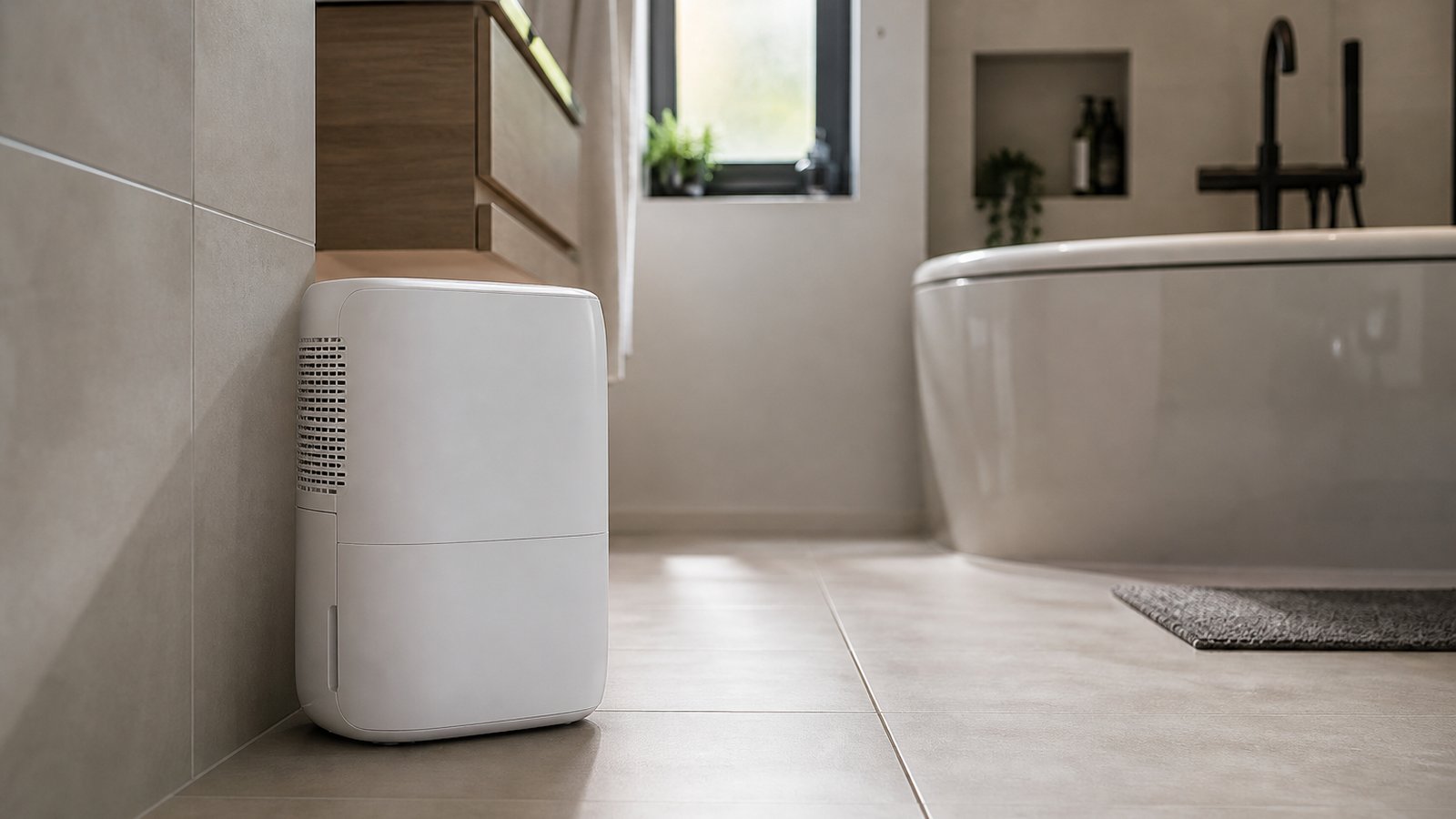
A wall-mount dehumidifier can keep a small bathroom floor clear, but mounting is not automatically the safest or most effective answer. Start by checking the source of the moisture, the bathroom electrical zones, the manufacturer’s installation instructions and the unit’s extraction performance at realistic room temperatures. For many homes, a portable dehumidifier used outside the wettest area is the more flexible choice.
The short answer
Choose a wall-mounted unit only when it is explicitly designed for fixed installation and a competent installer can place it outside direct spray and in a permitted electrical location. Do not put an ordinary portable appliance on a shelf and call it wall-mounted. If the room already has a working extractor fan, use it during bathing and leave it running for the recommended overrun period; a dehumidifier supports moisture control but does not replace ventilation or repair leaks.
Government guidance on damp and mould treats bathroom ventilation, heating, insulation and building defects as parts of the same diagnosis. That is the right frame for this purchase: the machine is one tool, not a cure for every damp mark.
First identify the moisture problem
Bathroom condensation is usually a short, intense load. Warm, moist air from a shower reaches a cold mirror, window or outside wall and condenses. A dehumidifier may shorten the drying period, but it cannot correct a leaking pipe, failed seal, penetrating damp or an extractor that does not vent outdoors.
Use this simple triage before shopping:
| What you see | Likely first action | Where a dehumidifier fits |
|---|---|---|
| Steam and wet mirrors after showers | Run and maintain the extractor; close the bathroom door while showering | Helps dry the room after the moisture source stops |
| Mould around a cold window or external corner | Improve ventilation and investigate cold surfaces or insulation | May reduce repeat condensation while the cause is addressed |
| A local wet patch that grows regardless of bathing | Check plumbing, seals, roof or wall defects | Do not use a machine to hide the fault |
| Damp towels and laundry drying slowly | Improve airflow and move wet textiles out where practical | Useful in a closed room with safe clearance |
Visible mould should be dealt with promptly and safely. Renters should report persistent damp and mould rather than accepting an appliance as a substitute for necessary repairs.
Wall-mounted, portable or passive absorber?
Purpose-built wall-mounted units
These suit a repeat problem in a compact room where floor space matters and the installation instructions permit the intended location. The advantages are consistent placement and fewer trailing leads. The disadvantages are installation cost, less flexibility and the need to service filters, drains or tanks in a fixed position.
Check whether “wall mount” means a true mounting kit supplied by the manufacturer. A marketing photograph or a convenient shelf is not evidence that a portable unit can safely be fixed to a wall.
Portable dehumidifiers
A portable model can be positioned in a nearby landing or moved between the bathroom, laundry room and conservatory. It is often the sensible first purchase when you are still learning where condensation is worst. The trade-off is floor space and cable management. Keep the appliance stable, preserve the stated air clearances and never route a lead where wet hands, splashes or trips are likely.
Passive and rechargeable absorbers
Passive tubs and small rechargeable desiccant units can help inside cupboards or other tiny enclosed spaces. They are not substitutes for powered extraction after family showers. Compare collection over a realistic period, not the size of the plastic case.
Seven specifications that matter
- Extraction rate under stated test conditions. A headline litres-per-day figure can be measured in warmer and wetter air than a UK bathroom in winter. Look for the temperature and relative humidity used for the rating.
- Operating temperature. Compressor models can lose effectiveness in cool rooms; other technologies may behave differently. Match the unit to the coldest likely room, not the summer temperature.
- Water management. Check the verified tank capacity, full-tank behaviour and whether continuous drainage is actually supported and included.
- Humidistat. A clear target setting is more useful than vague colour lights. It allows the unit to cycle rather than run continuously.
- Noise at the mode you will use. Compare measured sound figures where available and consider bedroom proximity.
- Power and running pattern. Running cost depends on watts, hours and your tariff. A smaller unit that runs all day can use more energy than a larger, efficient unit that reaches the target sooner.
- Installation and bathroom suitability. Confirm mounting hardware, ingress protection information, electrical instructions, warranty terms and who is permitted to install it.
The current Csmart Air product page can be used to verify the seller’s present specification and basket price. Treat any conflict between a category card, old article or product page as a reason to ask before buying, not as permission to choose the most attractive number.
A safe placement checklist
- Keep the unit outside direct spray and away from bath or shower edges.
- Follow the manufacturer’s minimum clearances around air inlets and outlets.
- Put portable units on a level, stable surface where they cannot fall.
- Do not use an extension lead in the bathroom to solve a placement problem.
- Do not drill or mount through hidden cables or pipes.
- Keep doors and windows in the position recommended for the chosen drying routine.
- Let a qualified electrician assess any fixed mains installation in a bathroom.
If safe placement is not possible, run a portable unit in the adjacent dry area with the bathroom door open after bathing, provided that arrangement follows its manual.
A one-week test that produces useful evidence
Do not judge the purchase from a single misty mirror. Record the room in a repeatable way for seven days:
- Note the starting humidity and temperature before the shower.
- Use the same extractor and door routine each day.
- Record how long visible condensation takes to clear.
- Measure how much water the unit collects, if its tank design allows this safely.
- Note noise, emptying frequency and whether towels and grout dry sooner.
- Stop and investigate if a wet patch does not track bathing or weather.
This does not turn a domestic test into a laboratory result. It does tell you whether the machine is practical in your room and whether the claimed capacity matches your actual moisture load.
Avoid these buying mistakes
- Buying by tank size instead of extraction performance.
- Assuming a model is bathroom-safe because the advert shows tiles.
- Treating a dehumidifier as a mould-removal or structural-damp service.
- Blocking trickle vents or switching off a working extractor to make the machine collect more water.
- Believing a fixed humidity percentage suits every home and season.
- Quoting a price, warranty or accessory from an old comparison page without checking the live seller page.
For a broader size and technology comparison, read the UK dehumidifier buying guide. Keep packaging and document the first-week test while the seller’s returns policy applies.
Frequently asked questions
Is a wall-mount dehumidifier better than a portable one for a bathroom?
Not automatically. A purpose-built fixed unit can save floor space, while a portable model is easier to move and trial. Safety, extraction performance, operating temperature and the manufacturer’s installation instructions matter more than the format alone.
Can a dehumidifier replace a bathroom extractor fan?
No. Ventilation removes moisture and indoor pollutants from the room. A dehumidifier recirculates air and collects some water. Government guidance prioritises effective bathroom ventilation and investigation of building defects.
What humidity should I aim for?
Use the appliance manual and observe the room rather than chasing one universal number. The useful outcome is controlled condensation without making the room uncomfortably dry or running the machine unnecessarily.
Can I mount a normal portable dehumidifier on a shelf?
Only if the manufacturer explicitly permits that arrangement and all safety clearances are met. Improvised mounting can obstruct airflow, make emptying unsafe and place an unsuitable appliance closer to water.
When should I stop troubleshooting and call a professional?
Get help when damp is localised, persistent, linked to rain or plumbing, accompanied by damaged plaster, or returns despite working ventilation and sensible moisture control.
Bottom line
The best bathroom dehumidifier is not simply the smallest box that can be attached to a wall. Diagnose the moisture, preserve ventilation, verify real extraction conditions and choose a format that can be positioned and maintained safely. A purpose-built wall-mounted unit can be excellent in the right room; a portable model is often the better first test when the diagnosis or placement is still uncertain.