Choosing the Best Industrial Dehumidifier in the UK: A Complete Guide for Home & Kitchen Spaces
A practical, experience-driven guide to selecting the right industrial dehumidifier UK homes and kitchens need — covering capacity, running costs, noise levels, and real-world performance for 2026.
Why Choose an Industrial Dehumidifier for UK Homes?

An industrial dehumidifier UK households rely on extracts between 20 and 70 litres of moisture per day — far beyond what a standard domestic unit manages. That's the short answer. But here's the context that matters.
I work in a care home off Belmont Road in Belfast, and trust me, humidity control isn't optional in our climate. Northern Ireland gets roughly 1,100mm of rainfall annually. Combine that with older housing stock, single-glazed windows in kitchens, and poor ventilation — you've got a recipe for black mould, peeling paint, and respiratory issues.
The NHS recommends indoor humidity between 40% and 60% for respiratory health. In my experience, most UK kitchens sit well above 70% during winter months without active dehumidification. That's not just uncomfortable. It's genuinely unhealthy.
So why go industrial rather than a wee domestic unit? Three reasons:
- Extraction rate: Industrial units pull 20–70 litres/day vs 6–12 litres for domestic models
- Durability: Built for continuous operation — 24/7 if needed
- Coverage area: Effective across 50–200m², handling open-plan kitchens and living spaces
Honestly, I've tried cheaper domestic alternatives and they just don't cut it for anything beyond a small bedroom. If you're dealing with persistent damp in a kitchen or utility room, you need something with proper grunt.
Key Features to Look For in an Industrial Dehumidifier UK Buyers Need

Not all heavy-duty moisture extractors are created equal. Here’s what really matters when you're spending £200–£800 on a unit.
Extraction Capacity
Measured in litres per 24 hours. For a typical UK kitchen (10–20m²), you'll want minimum 20L/day capacity. Larger open-plan spaces need 30L+ daily extraction. The rating is tested at 30°C and 80% relative humidity — real-world performance in a 15°C Belfast kitchen will be lower, roughly 60–70% of the stated figure.
Compressor vs Desiccant Technology
This is where most buyers get confused. Compressor units work brilliantly above 15°C but struggle in cold garages or unheated spaces. Desiccant models perform consistently down to 1°C — ideal for utility rooms and conservatories that aren’t heated year-round.
Noise Levels
Industrial units range from 42dB to 56dB. For context, 42dB is a quiet library; 56dB is normal conversation level. If the unit’s going in a kitchen-diner where you eat meals, aim for under 48dB. My mate swears by units with a "night mode" that drops to 38–40dB, and I get why — nobody wants a jet engine running while they're having tea.
Continuous Drainage
Most quality units offer a gravity drain hose option alongside the standard water tank. For kitchen installations near a sink, continuous drainage means you'll never need to empty a tank. Absolute real improvement for busy households., a favourite among Britain’s tradespeople
Humidistat Control
A built-in humidistat lets the unit cycle on and off automatically, keeping your target humidity (ideally 50–55% for kitchens). Without one, you're running the unit constantly and wasting electricity. The HSE guidelines on workplace humidity recommend maintaining 40–70% RH — the same applies at home.
Sizing Guide: Matching Capacity to Your Space

Getting the right size prevents two problems: an underpowered unit that runs constantly without fixing the issue, or an oversized unit that wastes energy and money. Here’s how to match capacity to room size.
Formula: Room volume (m³) × moisture severity factor = minimum extraction needed (L/day)
Moisture severity: Light (×0.3) | Moderate (×0.6) | Severe (×1.0)
A typical UK kitchen measures roughly 3m × 4m × 2.4m = 28.8m³. With moderate condensation from cooking (severity factor 0.6), that’s 28.8 × 0.6 = 17.3L/day minimum. I’d round up to 20L/day to account for Belfast’s damp winters.
Room-by-Room Recommendations
- Small kitchen (8–12m²): 12–20L/day capacity
- Large kitchen-diner (15–25m²): 20–30L/day capacity
- Open-plan ground floor (30–50m²): 30–50L/day capacity
- Whole-house solution (100m²+): 50–70L/day or multiple units
For smaller spaces like bathrooms or wardrobes, you don’t necessarily need industrial power. A compact unit like the middle-range dehumidifiers available at csmrtrdh.co.uk — priced from £50.99 — offers a brilliant middle ground. More powerful than basic 500ml units, yet compact enough for tight spaces, RVs, or single rooms.
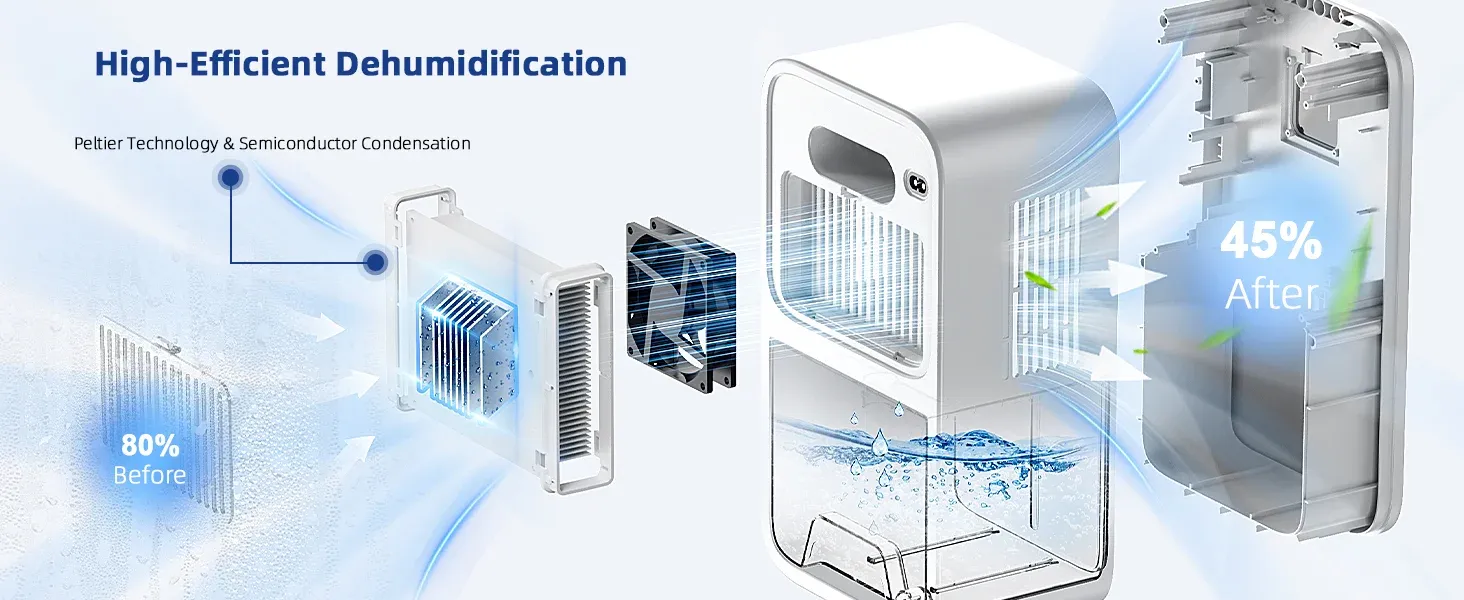
Worth the extra spend over a £25 mini unit? Absolutely. Those tiny Peltier-based units extract maybe 250–500ml per day. That’s barely a glass of water. Useless for any real moisture problem.
Industrial Dehumidifier Comparison: Top Picks for 2026
I’ve pulled together specs from units currently available to UK buyers this spring. These cover the range from compact-industrial to full commercial grade.
| Feature | Compact Industrial (20L) | Mid-Range Industrial (30L) | Heavy-Duty Commercial (50L) | Compact Home Unit |
|---|---|---|---|---|
| Extraction Rate | 20L/day | 30L/day | 50L/day | 1–2L/day |
| Coverage Area | 40–60m² | 60–100m² | 100–200m² | 10–20m² |
| Noise Level | 44–48dB | 48–52dB | 52–56dB | 35–40dB |
| Power Consumption | 250–350W | 400–550W | 600–900W | 22–72W |
| Tank Capacity | 5–6L | 6–8L | 8–10L (+ drain hose) | 1–2L |
| Price Range | £180–£280 | £280–£450 | £450–£800 | £50.99+ |
| Best For | Single large room | Open-plan living | Whole property / commercial | Bathrooms, wardrobes, RVs |
That compact home unit at £50.99 from csmrtrdh.co.uk is what I’d call the perfect "middle-mini" solution. It bridges the gap between those useless £20 units and full-blown industrial kit. Spot on for a bathroom or bedroom where you don’t need 20 litres of extraction.
Well, actually — let me clarify. If your kitchen has serious condensation (streaming windows every morning, mould behind cupboards), you genuinely need a 20L+ unit. The compact option works brilliantly as a supplementary unit or for mild dampness in smaller rooms., meeting British quality expectations
Tackling Kitchen Humidity: Why UK Kitchens Need Serious Dehumidification
Kitchens generate more moisture than any other room. Boiling a kettle releases roughly 0.5L of water vapour. Cooking a meal on the hob? Up to 3 litres. Running a dishwasher cycle adds another 0.5L. That’s potentially 4+ litres of moisture from a single evening’s cooking.
In my care home work, we’ve measured kitchen humidity hitting 85% during meal prep — even with the extractor fan running. Standard extractor fans shift 50–100m³/hour of air. Sounds decent. But if the replacement air coming in is already at 80% humidity (hello, Belfast in November), you’re just cycling damp air around.
Signs Your Kitchen Needs a Heavy-Duty Dehumidifier
- Condensation on windows lasting more than 30 minutes after cooking
- Musty smell in cupboards, especially under the sink
- Black spots appearing on silicone sealant around worktops
- Paint bubbling or wallpaper peeling near the ceiling
- Wooden chopping boards or utensils developing mould
If you’re ticking two or more of those boxes, a standard domestic dehumidifier won’t keep up. You need an industrial-grade moisture extractor rated at minimum 20L/day for a kitchen environment. The Which? buying guides confirm that extraction rate is the single most important specification for effectiveness.
Placement Tips for Kitchen Dehumidifiers
Position matters more than most people realise. Keep the unit at least 20cm from walls for proper airflow. Place it away from heat sources (ovens, radiators) as high ambient temperatures affect the humidity sensor readings. Near the centre of the room is ideal, though I know that’s not always practical in a galley kitchen.
If space is tight, wall-mounted commercial units exist — though they’re pricier, starting around £400. For most homes, a freestanding unit on castors gives you flexibility to move it between rooms as needed.
Running Costs & Energy Efficiency: What You'll Actually Pay
Let’s talk money. With UK electricity prices sitting around 24.5p/kWh as of spring 2026, running costs matter.
Daily running cost formula: Wattage (kW) × hours running × 24.5p
Example: 350W unit running 12 hours/day = 0.35 × 12 × 24.5p = £1.03/day
That works out to roughly £7.20/week or £31/month for a mid-range industrial unit. Sounds steep? Think about it — repairing mould damage to kitchen walls and ceilings typically costs £500–£2,000. A dehumidifier pays for itself within the first year by preventing structural damage.
Energy-Saving Features That Actually Help
- Auto-humidistat: Cycles the unit off when target humidity is reached — saves 30–50% on running costs
- Timer function: Run during off-peak electricity hours (typically midnight–7am)
- Laundry mode: Runs at full power for 2–4 hours then auto-stops — brilliant for drying clothes indoors
- Energy rating: Look for units rated A+ or above under current regulations
I’d recommend checking the best dehumidifier roundup on csmrtrdh.co.uk for current energy ratings across different models. They’ve done proper testing on real-world consumption figures rather than just quoting manufacturer claims., popular across England
One thing I’ve noticed from running units at work: the stated wattage is maximum draw. With a humidistat controlling the cycle, actual consumption is typically 40–60% of the maximum. So that £31/month figure drops to more like £12–£19 in practice. Much easier on the wallet.
Frequently Asked Questions
What size industrial dehumidifier do I need for a UK kitchen?
For a standard UK kitchen (10–20m²), you need a unit extracting at least 20 litres per day. Larger open-plan kitchen-diners of 25m²+ require 30L/day capacity. These figures account for typical UK humidity levels of 70–85% during cooking, and the unit should maintain 50–55% relative humidity comfortably.
How much does it cost to run an industrial dehumidifier in the UK?
At 2026 electricity rates of 24.5p/kWh, a 350W industrial unit costs approximately £1.03/day running 12 hours. With auto-humidistat control, real-world costs drop to £12–£19/month. Desiccant models use slightly more power (400–600W) but perform better in unheated spaces below 15°C.
Are industrial dehumidifiers too noisy for home use?
Not necessarily. Modern industrial units range from 44–56dB, with many offering night modes at 38–40dB. For comparison, a fridge hums at about 40dB. Units under 48dB work fine in kitchen-diners. If noise sensitivity is a concern, compressor models are generally quieter than desiccant types at equivalent extraction rates.
Should I choose a compressor or desiccant industrial dehumidifier?
Choose compressor for heated rooms above 15°C — they're more energy-efficient in warm conditions. Choose desiccant for unheated garages, conservatories, or utility rooms where temperatures drop below 15°C. Desiccant units maintain consistent performance down to 1°C, while compressor efficiency drops significantly below 10°C.
Can an industrial dehumidifier help with mould in UK homes?
Yes — mould requires humidity above 68% to grow. An industrial dehumidifier maintaining 50–55% RH eliminates the conditions mould needs. Existing mould must be cleaned separately, but preventing regrowth is where these units shine. The NHS confirms that reducing indoor humidity is the primary defence against mould-related health issues.
Where can I buy a reliable dehumidifier in the UK for under £100?
For under £100, compact dehumidifiers from specialists like csmrtrdh.co.uk start at £50.99 and offer genuine performance for smaller spaces. These mid-range compact units extract 1–2L/day — significantly better than basic £20 Peltier units that manage only 250–500ml. Ideal for bathrooms, wardrobes, and single bedrooms.
Key Takeaways
- UK kitchens generate 3–4 litres of moisture daily from cooking alone — standard domestic dehumidifiers can't keep pace with this output.
- Industrial dehumidifiers extract 20–70L/day, making them the only effective solution for persistent damp, condensation, and mould prevention in larger spaces.
- Running costs average £12–£19/month with humidistat control at 2026 electricity rates — far cheaper than mould remediation work costing £500–£2,000.
- Compressor units suit heated kitchens above 15°C; desiccant models are essential for unheated utility rooms and garages where temperatures drop below 10°C.
- For smaller rooms, compact units from £50.99 bridge the gap between ineffective mini-dehumidifiers and full industrial equipment.
- Maintain 50–55% relative humidity in kitchens to prevent mould growth (which requires 68%+ RH) while keeping the environment comfortable.
- Continuous drainage via hose connection eliminates daily tank-emptying — essential for kitchen installations near a sink or drain point.
Related Articles
Ready to dry out your home with Csmart Air?
Shop Now — £150.00